


Redefining learning in the digital era: Innovative tools shaping modern medical education
##plugins.themes.academic_pro.article.sidebar##
##plugins.themes.academic_pro.article.main##
Abstract
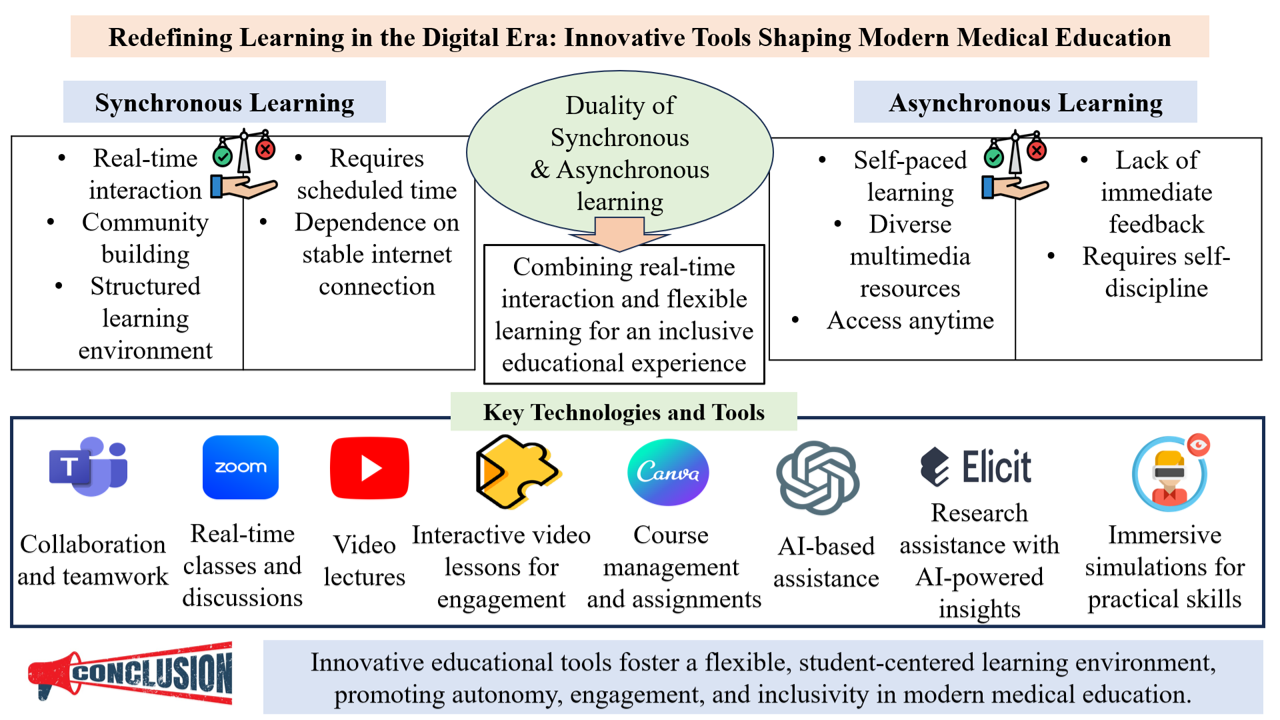
The rapid development of digital tools for medical education and training has expanded the possibilities for flexible and personalized learning, but it has also created challenges in choosing the best tools to meet specific learning needs. This article presents a functional framework that assists educators and learners in selecting tools based on their needs and the learning context. By categorizing tools into synchronous and asynchronous types, we aim to simplify the decision-making process and optimize educational experiences. Synchronous learning tools like YouTube Live, PathCast, Zoom and Microsoft Teams support real-time participation and promote communication, collaboration and responsiveness in the learning environment. These tools are especially useful for live streaming, Q&A, and discussions where instant feedback can support learning outcomes. Asynchronous learning tools such as YouTube, Canvas, Elicit and Quizlet, give learners the flexibility to learn material at their own pace, encouraging independent learning and memorization. Asynchronous platforms allow for pausing, reviewing and repeating material as needed, making them ideal for complex courses that require effective repetition. Hybrid models, especially the flipped classroom approach, blend these modes effectively. Tools like Edpuzzle and Nearpod make it possible to create interactive lessons and exercises in the classroom. The integration of innovative technology in medical education is not solely about adopting new tools but also about promoting adaptability and a culture of continuous learning. Blending synchronous and asynchronous tools with a human-centered approach, can build flexible, responsive learning environments that empower educators and learners to make informed choices, creating adaptive and effective learning environments that meet diverse needs.
Keywords:
innovative tools, medical education, synchronous learning, asynchronous learning##plugins.themes.academic_pro.article.details##

This work is licensed under a Creative Commons Attribution-NonCommercial-NoDerivatives 4.0 International License.
References
- Chai SS, Ting SH, Goh KL, Chang YHR, Wee BL, Novita D, et al. Beyond digital interfaces: The human element in online teaching and its influence on student experiences. PLOS ONE. 2024;19(7):e0307262.
- Spencer JA, Jordan RK. Learner centred approaches in medical education. BMJ. 1999;318(7193):1280‑3.
- Komasawa N, Yokohira M. Learner-Centered Experience-Based Medical Education in an AI-Driven Society: A Literature Review. Cureus [Internet]. 2023 [cited 2024 Oct 29]; Available from: https://www.cureus.com/articles/195518-learner-centered-experience-based-medical-education-in-an-ai-driven-society-a-literature-review
- Sarkar M, Liu K, Kumar A, Ilic D, Morphet J, Maloney S, et al. Student and Educator Perspectives of Adapting to Remote Health Professions Education: A Mixed-Methods Study. Front Med. 2022;9:834228.
- Tobin B, Farren M, Crotty Y. Impacting teaching and learning through collaborative reflective practice. Educ Action Res [Internet]. 2024 [cited2024 Oct 29]; Available from: https://www.tandfonline.com/doi/abs/10.1080/09650792.2024.2394933
- Densen P. Challenges and Opportunities Facing Medical Education. Trans Am Clin Climatol Assoc. 2011;122:48.
- Bajwa J, Munir U, Nori A, Williams B. Artificial intelligence in healthcare: transforming the practice of medicine. Future Healthc J.2021;8(2):e188.
- Mhlanga D. Digital transformation of education, the limitations and prospects of introducing the fourth industrial revolution asynchronous online learning in emerging markets. Discov Educ. 2024;3(1):32.
- Mao S, Guo L, Li P, Shen K, Jiang M, Liu Y. New era of medical education: asynchronous and synchronous online teaching during and after COVID-19. Adv Physiol Educ. 2023;47(2):272.
- Chauhan V. Synchronous and Asynchronous Learning. Imp J Interdiscip Res [Internet]. 2017 [cited 2024 Oct 29]; Available from: https://www.semanticscholar.org/paper/Synchronous-and-Asynchronous-Learning-Chauhan/48c279efde31e1b09dbc5368bddb7457fb9965e9
- Zeng H, Luo J. Effectiveness of synchronous and asynchronous online learning: a meta-analysis. Interact Learn Environ. 2024;32(8):4297‑313.
- Intan Nuyulis Naeni Puspitasari. Combination of Synchronous and Asynchronous Models in Online Learning. J Pendidik Islam Indones. 2021;5(2):198‑217.
- Amiti F. SYNCHRONOUS AND ASYNCHRONOUS E-LEARNING. Eur J Open Educ E-Learn Stud [Internet]. 2020 [cited 2024 Oct 29];5(2). Available from: https://oapub.org/edu/index.php/ejoe/article/view/3313
- Anwar MI, Naeem MT, Aamir Jameel M, Jameel H, Tahir S. A Cross-Sectional Study on the Impact of Synchronous Learning among Medical Students during Covid 19 Pandemic: A Case Study of SKZMC, Lahore. Pak J Med Health Sci. 2022;16(2):207‑9.
- Potyazhenko MM, Sokolyuk NL, Lyulka NO, Kitura OE, Nastroga TV, Nevoit GV, et al. Problems of medical education and implementation of digital learning model in training future physicians in specialty "Internal Diseases" during COVID-19 pandemic and full-scale war in Ukraine. Aktual Probl Suchas Med Visn Ukr Med Stomatol Acad. 2022 Nov 29;22:194-8
- Kohnke L, Moorhouse BL. Facilitating Synchronous Online Language Learning through Zoom. RELC J. 2022;53(1):296‑301.
- Huey M. The Impact of Synchronous Zoom Learning on Course Comprehension and Psychological Well-Being in the College Classroom. J Sch Educ Psychol [Internet]. 2024 [cited 2024 Oct 2024];4(1). Available from: https://journalofschoolpsychology.com/index.php/josep/article/view/52
- Idleman BJ. Cast a wider net: Leveraging Canvas for asynchronous information literacy learning. Coll Undergrad Libr. 2022;29(1‑2):78‑99.
- Andresen MA. Asynchronous Discussion Forums: Success Factors, Outcomes, Assessments, and Limitations. J Educ Technol Soc [Internet]. 2009 [cited Oct 2024]; Available from: https://www.semanticscholar.org/paper/Asynchronous-Discussion-Forums%3A-Success-Factors%2C-Andresen/8d597d999d822456df418f9ec9c018af1ebc963f
- Chavan S. Augmented Reality vs. Virtual Reality: Differences and Similarities. 2016 [cited2024 Oct 29]. Available from: https://www.semanticscholar.org/paper/Augmented-Reality-vs.-Virtual-Reality%3A-Differences-Chavan/7dda32ae482e926941c872990840d654f9e761ba
- Hamilton D, McKechnie J, Edgerton E, Wilson C. Immersive virtual reality as a pedagogical tool in education: a systematic literature review of quantitative learning outcomes and experimental design. J Comput Educ. 2021;8(1):1‑32.
- Nanda I, Monirujjaman Khan M, Saleh Md Fahim KA, Tauqir Rayhan M, Sattar Sohel I, Ahmed Rakin SS, et al. Teaching medical students about human anatomy using virtual reality: a novel approach. In: International Conference on Power Electronics & Sustainable Development (ICPESD) [Internet]. Volkson Press; 2022 [cited 2024 Oct 29]. p. 211-4. Available from: https://www.intelcomp-design.com/paper/3icpesd2022/211-214.pdf
- Banerjee S, Pham T, Eastaway A, Auffermann WF, Quigley EP. The Use of Virtual Reality in Teaching Three-Dimensional Anatomy and Pathology on CT. J Digit Imaging. 2023;36(3):1279‑84.
- Shoufan A, Mohamed F. YouTube and Education: A Scoping Review. IEEE Access. 2022;10:125576‑99.
- Araújo Da Silva KK, Machado LR, Ribeiro Ribeiro AC, Da Silva JS, Behar PA. Reporting an experiment live-streaming classes in a distance learning course. In: Proceedings of the 7th International Conference on Educational Technologies 2020 [Internet]. IADIS Press; 2020 [cited 2024 Nov 10]. p. 65-71. Available from: http://www.iadisportal.org/digital-library/reporting-an-experiment-live-streaming-classes-in-a-distance-learning-course
- Madrigal E, Mannan R. pathCast: An Interactive Medical Education Curriculum That Leverages Livestreaming on Facebook and YouTube. Acad Med. 2020;95(5):744‑50.
- Zaidi SJA, Kazmi S, Shahid Shamim M. Ways of Engaging Students Through Zoom and Avoiding Zoom Fatigue. Pak J Public Health. 2022;11(4):211‑3.
- Tan HCL, Tan JH, Sagap I. Use of contemporary live TELE‐VIDEO conferencing for continuing surgical training at the time of COVID ‐19 pandemic. ANZ J Surg. 2020;90(7‑8):1526‑1526.
- Hidayat S, Lovita ID, Zakiyah Z, Mimin M, Nurpratiwi A. The Effectiveness of Online Learning Using Zoom Meetings at Elementary Schools. Int J Technol Educ Sci. 2022;6(4):559‑68.
- Liao SC, Chen W, Tai CJ. Enhancing medical ethics instruction with a classroom response system. Med Educ. 2009;43(5):487‑8.
- Shrivastava SR, Shrivastava PS. Justifying the inclusion of audience response system for the delivery of medical education. Muller J Med Sci Res. 2021;12(1):39‑41.
- Castillo S, Thomas L, Yarlagadda S, Ahmed Y, Newman JR. Poll Everywhere to Encourage Learner Satisfaction and Participation in Internal Medicine Fellowship Didactics. Cureus [Internet]. 2020 [cited 2024 Nov 7]; Available from: https://www.cureus.com/articles/27872-poll-everywhere-to-encourage-learner-satisfaction-and-participation-in-internal-medicine-fellowship-didactics
- Odeh H, Kaddumi EG, Salameh MA, Al-Khader A. Interactive Online Practical Histology Using the Poll Everywhere Audience Response System: An Experience During the COVID-19 Lockdown. Int J Morphol. 2022;40(1):102‑6.
- Sikarwar AS. Flipped Classroom with Poll Everywhere: Engaging Students with Active Learning in Large Group Settings. J Asian Sci Res. 2015;5(2):111‑9.
- Mustafa AG, Taha NR, Alshboul OA, Alsalem M, Malki MI. Using YouTube to Learn Anatomy: Perspectives of Jordanian Medical Students. BioMed Res Int. 2020;2020:1‑8.
- Curran V, Simmons K, Matthews L, Fleet L, Gustafson DL, Fairbridge NA, et al. YouTube as an Educational Resource in Medical Education: a Scoping Review. Med Sci Educ. 2020;30(4):1775‑82.
- Jeong S, Hwang H. Do we need Moodle in medical education? A review of its impact and utility. Kosin Med J. 2023;38(3):159‑68.
- Beck Dallaghan GL, Lomis K, Crow S, Coplit L. Bridging educational innovation and financial offices: using the Business Model Canvas modified for medical educators to communicate need. J Commun Healthc. 2022;15(2):131‑6.
- Kung JY. Elicit. J Can Health Libr Assoc. 2023;44(1):15.
- Aktay S. AI in academia: analysis of Elicit AI tool. 2024.
- Montenegro-Rueda M, Fernández-Cerero J, Fernández-Batanero JM, López-Meneses E. Impact of the Implementation of ChatGPT in Education: A Systematic Review. Computers.2023;12(8):153.
- Lo CK. What Is the Impact of ChatGPT on Education? A Rapid Review of the Literature. Educ Sci. 2023;13(4):410.
- Alkhaaldi SMI, Kassab CH, Dimassi Z, Alsoud LO, Fahim MA, Hageh CA, et al. Medical Student Experiences and Perceptions of ChatGPT and Artificial Intelligence: Cross-Sectional Study. JMIR Med Educ. 2023;9(1):e51302.
- Kipp M. From GPT-3.5 to GPT-4.o: A Leap in AI’s Medical Exam Performance. Information. 2024;15(9):543.
- Dengri C, Gill A, Chopra J, Dengri C, Koritala T, Khedr A, et al. A Review of the Quiz, as a New Dimension in Medical Education. Cureus [Internet]. 2021 [cited 2024 Nov 7]; Available from: https://www.cureus.com/articles/71482-a-review-of-the-quiz-as-a-new-dimension-in-medical-education
- Zeitlin BD, Sadhak ND. Attitudes of an international student cohort to the Quizlet study system employed in an advanced clinical health care review course. Educ Inf Technol. 2023;28(4):3833‑57.
- Mishall PL, Burton W, Risley M. Flashcards: The Preferred Online Game-Based Study Tool Self-Selected by Students to Review Medical Histology Image Content. In: Abdel Meguid E, Mishall PL, Nation HL, Rea PM, éditeurs. Biomedical Visualisation [Internet]. Cham: Springer International Publishing; 2023 [cited 2024 Nov 7]. p. 209‑24. (Advances in Experimental Medicine and Biology; vol. 1406). Available from: https://link.springer.com/10.1007/978-3-031-26462-7_10
- Yeh DD, Park YS. Improving Learning Efficiency of Factual Knowledge in Medical Education. J Surg Educ. 2015;72(5):882‑9.
- Amini A, Damanik DR, Sihombing ZA, Rangkuti VSM, Rusli R. Pengembangan materi pembelajaran bahasa di sekolah dasar. Perspekt J Pendidik Dan Ilmu Bhs. 2023 Dec 27;2(1):61‑6.
- Park JC, Kwon HJE, Chung CW. Innovative digital tools for new trends in teaching and assessment methods in medical and dental education. J Educ Eval Health Prof. 2021;18:13.
- Galvez R, Wallon RC, Shackelford L, Amos JR, Rowen JL. Use of Virtual Reality to Educate Undergraduate Medical Students on Cardiac Peripheral and Collateral Circulation. Med Sci Educ. 2021;31(1):19‑22.
- Bordes SJ, Walker D, Modica LJ, Buckland J, Sobering AK. Towards the optimal use of video recordings to support the flipped classroom in medical school basic sciences education. Med Educ Online. 2021;26(1):1841406.
- Joshi MK. Novel teaching–learning and assessment tools to complement competency-based medical education in postgraduate training. Indian J Anaesth. 2024;68(1):11‑6.
- Collins E, Ahmad A, May H, Price K, Egbase E, Mathews C. Transforming postgraduate medical education during the COVID-19 pandemic: creating a trainee-led virtual teaching platform. Future Healthc J. 2021;8(1):e7‑10.
- Tindale RS, Winget JR. Learning While Deciding in Groups. In: Argote L, Levine JM, éditeurs. The Oxford Handbook of Group and Organizational Learning [Internet]. Oxford University Press; 2020 [cité 28 janv 2025]. p. 154‑74. Disponible sur: https://academic.oup.com/edited-volume/28140/chapter/212900297
- Jones RB, Maramba I, Boulos MNK, Alexander T. Use of Live Interactive Webcasting for an International Postgraduate Module in eHealth: Case Study Evaluation. J Med Internet Res. 2009;11(4):e46.
- Watters G. Continuing Professional Development. In: Loh E, Long PW, éditeurs. Textbook of Medical Administration and Leadership [Internet]. Singapore: Springer Nature Singapore; 2023 [cité 23 janv 2025]. p. 31‑48. Disponible sur: https://link.springer.com/10.1007/978-981-99-5211-3_3
- Jampani R, Nayanatara V. Review article on continuing medical education activities. Indian J Orthop Surg. 2020;6(3):154‑60.
- Farid G, Rasul S, Jaleel ProfA, Zahid Bashir ProfM. Exploring the Impact of Chat GPT on Medical Education and Research: A Comprehensive Review (Preprint) [Internet]. Journal of Medical Internet Research; 2024 [cité 23 janv 2025]. Disponible sur: http://preprints.jmir.org/preprint/56232
- Hsu MH, Chen YH. Personalized Medical Terminology Learning Game: Guess the Term. Games Health J. 2024;13(2):84‑92.
- Bishop J, Verleger M. The Flipped Classroom: A Survey of the Research. In: 2013 ASEE Annual Conference & Exposition Proceedings [Internet]. Atlanta, Georgia: ASEE Conferences; 2013 [cité 7 nov 2024]. p. 23.1200.1-23.1200.18. Disponible sur: http://peer.asee.org/22585
- Graham KL, Cohen A, Reynolds EE, Huang GC. Effect of a Flipped Classroom on Knowledge Acquisition and Retention in an Internal Medicine Residency Program. J Grad Med Educ. 2019;11(1):92‑7.
- Hew KF, Lo CK. Flipped classroom improves student learning in health professions education: a meta-analysis. BMC Med Educ. 2018;18(1):38.
- Nichat A, Gajbe U, Bankar NJ, Singh BR, Badge AK. Flipped classrooms in medical education: improving learning outcomes and engaging students in critical thinking skills. Cureus. 2023 Nov 3;15(11):e48199. doi: 10.7759/cureus.48199. PMID: 38054140; PMCID: PMC10694389.
- Hurtubise L, Hall E, Sheridan L, Han H. The Flipped Classroom in Medical Education: Engaging Students to Build Competency. J Med Educ Curric Dev. 2015;2:JMECD.S23895.
- Shelby SJ, Fralish ZD. Using Edpuzzle to improve student experience and performance in the biochemistry laboratory. Biochem Mol Biol Educ. 2021;49(4):529‑34.
- Zain-Alabdeen EH. Evaluation and Perception of an Edpuzzle Class Compared with a Traditional Class among Oral Radiology Undergraduate Students. Eur J Gen Dent. 2023;12(02):115‑20.
- Messina DM, Mikhail SS, Messina MJ, Novopoltseva IA. Assessment of learning outcomes of first year dental students using an interactive Nearpod educational platform. J Dent Educ. 2022;86(7):893‑9.
- Buttrey K. Inclusion, engagement, and Nearpod: providing a digital alternative to traditional instruction. Ky Teach Educ J [Internet]. 2021;8(1):Article 2. Available from: https://doi.org/10.61611/2995-5904.1031
- Yarhere IE, Obuzor IO, Fomsi E. Online Learning Using Google Classroom: Undergraduate Medical Students and Paediatric Residents Perspectives in the University of Port Harcourt, Nigeria. Int J Trop Dis Health. 8 déc 2020;8‑15.
- Perception of Undergraduate Medical and Dental Students Towards Learning Anatomy in Google Classroom. Indian J Public Health Res Dev [Internet]. 23 oct 2020 [cité 7 nov 2024]; Disponible sur: http://medicopublication.com/index.php/ijphrd/article/view/11100
- Dash S. Google classroom as a learning management system to teach biochemistry in a medical school. Biochem Mol Biol Educ. 2019;47(4):404‑7.
- Rahmania F, Khairana C, Zulmi Y, Krisnawati I, Adriantoni A. Educators and Students. Educ Achiev J Sci Res. 2024;616‑20.
- Guo Y, Lee D. Leveraging ChatGPT for Enhancing Critical Thinking Skills. J Chem Educ. 2023;100(12):4876‑83.
- Oudat Q, Othman M. Embracing digital learning: Benefits and challenges of using Canvas in education. J Nurs Educ Pract. 2024;14(10):39.
- Mangaroska K, Vesin B, Giannakos M. Cross-platform analytics: a step towards personalization and adaptation in education. In: Proceedings of the 9th International Conference on Learning Analytics & Knowledge (LAK19). New York, NY, USA: Association for Computing Machinery; 2019. p. 71-75. doi: 10.1145/3303772.3303825.
- Kelly K, Lock E. That synching feeling: an exploration of student engagement in an online environment. Stud Success. 2021;12(3):48-57. doi: 10.5204/ssj.1771.
- Mirmoghtadaie Z, Mohammadimehr M. Student support system in virtual learning environment for medical education: McKenna content analysis method. Preprint [Internet]. Research Square; 2020 Aug 20 [cited 2025 Feb 11]. Available from: https://doi.org/10.21203/rs.3.rs-55477/v1
- Siegel-Stechler K. “Conversation is everything”: How teachers and students create environments where open discussion can thrive. Theory Res Soc Educ. 2023;51(4):626‑60.
- Jiang P. Unleashing the potential of ChatGPT: empowering enhanced active learning in the classroom compared to conventional passive learning. In: Abstracts of the 5th World Conference on Arts, Humanities, Social Sciences and Education [Internet]. Eurasia Conferences; 2024. p. 32-32. [cited 2025 Jan 31]. Available from: https://eurasiaconferences.com/proceedings/abstracts-of-the-5th-world-conference-on-arts-humanities-social-sciences-and-education/abstracts/286
- Yogeswaran V, El Morr C. Effectiveness of online mindfulness interventions on medical students’ mental health: a systematic review. BMC Public Health. 2021;21(1):2293.
- Wasson LT, Cusmano A, Meli L, Louh I, Falzon L, Hampsey M, et al. Association Between Learning Environment Interventions and Medical Student Well-being: A Systematic Review. JAMA. 2016;316(21):2237.
- Frajerman A. Quelles interventions pour améliorer le bien-être des étudiants en médecine ? Une revue de la littérature. L’Encéphale. 2020;46(1):55‑64.
- Flint A. Book Review of An active student participation companion. Int J Stud Partn. 2020;4(1):162‑3.
- Abbas H. Transforming education: the role of Artificial Intelligence. Stud Eng EXACT Sci. 2024;5(3):e12579.
- Jiang P. Unleashing the potential of ChatGPT: empowering enhanced active learning in the classroom compared to conventional passive learning. In: Abstracts of the 5th World Conference on Arts, Humanities, Social Sciences and Education [Internet]. Eurasia Conferences; 2024. p. 32-32. [cited 2025 Jan 31]. Available from: https://eurasiaconferences.com/proceedings/abstracts-of-the-5th-world-conference-on-arts-humanities-social-sciences-and-education/abstracts/286
- Al Shloul T, Mazhar T, Abbas Q, Iqbal M, Ghadi YY, Shahzad T, et al. Role of activity-based learning and ChatGPT on students’ performance in education. Comput Educ Artif Intell. 2024;6:100219.
- Ngo TTA. The Perception by University Students of the Use of ChatGPT in Education. Int J Emerg Technol Learn IJET. 2023;18(17):4‑19.
- Ali D, Fatemi Y, Boskabadi E, Nikfar M, Ugwuoke J, Ali H. ChatGPT in Teaching and Learning: A Systematic Review. Educ Sci. 2024;14(6):643.
- Tuma F, Aljazeeri J. Asynchronous group learning in learn from the learner approach: a learning object that enhances and facilitates distance self and shared learning. Ann Med Surg (Lond). 2021 Jul 2;67:102535. doi: 10.1016/j.amsu.2021.102535. PMID: 34295464; PMCID: PMC8282459.
- Li EY, Tsai SDC, Macnow A. Clinical Learning in a Time of COVID-19: Perspectives from Clerkship Students. MedEdPublish [Internet]. 2021 [cité 31 janv 2025];10(1). Disponible sur: https://mededpublish.org/articles/10-68
- Rabee R, Najim M, Sherwani Y, Ahmed M, Ashraf M, Al-Jibury O, et al. YouTube in medical education: a student’s perspective. Med Educ Online. 2015;20(1):29507.
- Clifton A, Mann C. Can YouTube enhance student nurse learning? Nurse Educ Today. 2011;31(4):311‑3.
- Prober CG, Khan S. Medical Education Reimagined: A Call to Action. Acad Med. oct 2013;88(10):1407‑10.
- Dey AK. Narrowing the digital divide: building a sense of community using online tools in a post-pandemic world. Int J Innov Online Educ [Internet]. 2021;5(3). [cited 2024 Nov 10]. Available from: https://onlineinnovationsjournal.com/streams/scholarship-of-online-teaching-and-learning/7c8f570c3c1a4bfd.html96. Khalil H, Ebner M. Using Electronic Communication Tools in Online Group Activities to Develop Collaborative Learning Skills. Univers J Educ Res. 2017;5(4):529‑36.
- Anderi E, Sherman L, Saymuah S, Ayers E, Kromrei HT. Learning communities engage medical students: a COVID-19 virtual conversation series. Cureus. 2020 Aug 6;12(8):e9593. doi: 10.7759/cureus.9593. PMID: 32923199; PMCID: PMC7478637.
- Fenech M, Mead N, Fenech N. ‘Virtual café’ sessions: supporting medical sonography students learning anatomy online. Reflective Pract. 2024;25(1):74‑86.
- M.R RK. Teacher-Student Feedback Dynamics And Their Implications For Effective Teaching. Educ Adm Theory Pract. 2024;9671‑7.